Summit Shifts: Altitude's Role in Shifting Odds for Football and Basketball Encounters

High-altitude venues create measurable performance gaps that directly influence betting markets for both football and basketball, with data from multiple seasons showing consistent patterns in scoring, fatigue, and outcome probabilities. Researchers tracking physiological responses have documented how reduced oxygen levels at elevations above 1,500 meters alter player endurance, recovery times, and tactical execution across these two sports.
Altitude Effects on Football Performance Metrics
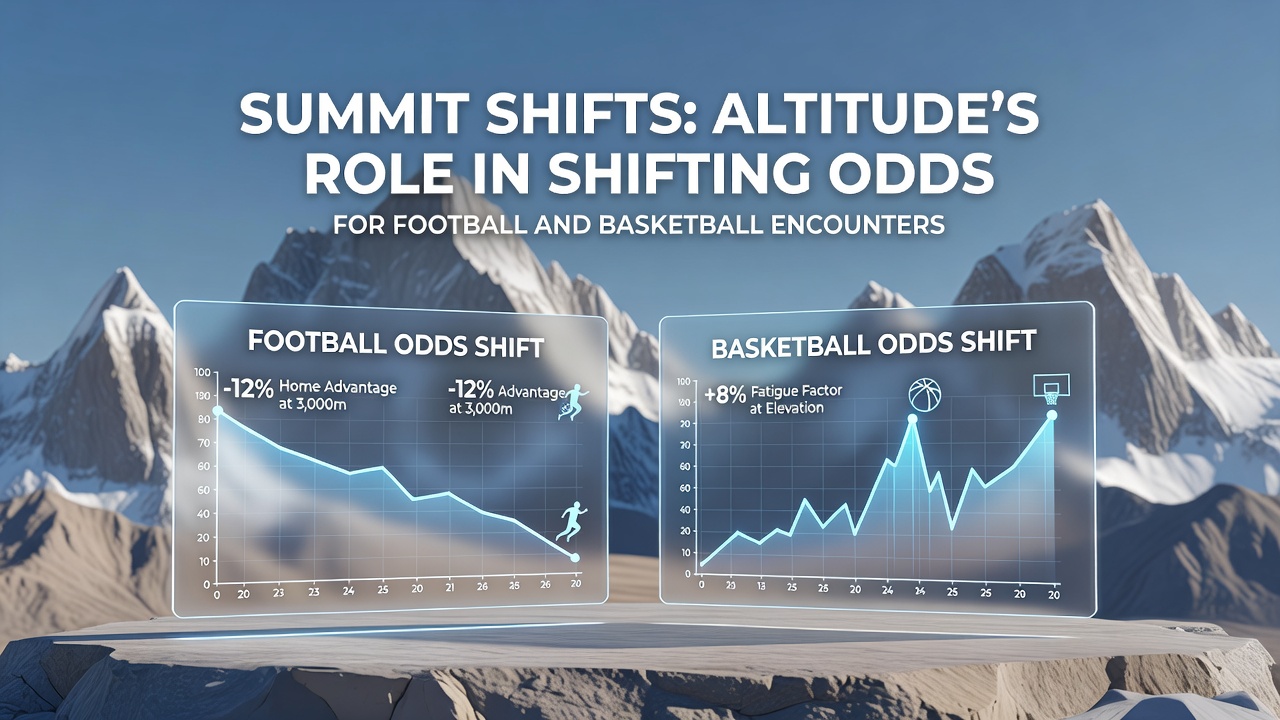
Football matches at sites like Estadio Hernando Siles in La Paz, Bolivia, which sits at 3,650 meters, produce distinct statistical shifts compared to sea-level contests, including lower total goals and higher home-team win rates. Studies from sports physiology labs indicate that visiting squads experience a 15 to 20 percent drop in high-intensity running distance during the second half, while local players maintain closer to baseline output due to acclimatization.
European clubs traveling to CONMEBOL qualifiers in June 2026 face similar conditions at venues in Quito and Bogotá, where historical match logs reveal visiting teams concede 0.8 more goals per game on average than they do in domestic leagues. Betting operators adjust pre-match lines accordingly, often moving totals downward by half a goal when the fixture occurs above 2,500 meters.
Basketball Dynamics at Elevation
In basketball the impact appears in different metrics yet produces comparable market movements, particularly in the NBA where the Denver Nuggets play at 1,609 meters and the Utah Jazz at 1,280 meters. League tracking data shows increased three-point attempt rates at these arenas because thinner air allows slightly longer ball flight distances, while defensive rebounding percentages dip due to reduced vertical leap capacity after repeated possessions.
Visiting teams in Denver record field-goal percentages 3.2 points lower than their season averages according to NBA advanced stats archives, a gap that widens further during back-to-back road games involving additional travel fatigue. Sportsbooks respond by shading player prop lines on points and rebounds for opposing frontcourts, creating value opportunities when public betting remains anchored to sea-level performance expectations.
Cross-Sport Data Patterns and Market Adjustments
Comparative analysis across both sports highlights shared physiological triggers, yet the betting implications diverge based on game structure. Football's continuous play amplifies cumulative oxygen debt, whereas basketball's frequent substitutions allow coaches to manage minute loads more precisely. Australian Institute of Sport reports on elite athletes note that acclimatization protocols require at least 10 to 14 days for full adaptation, a timeline rarely available during congested international calendars.
Bookmakers incorporate these variables through proprietary models that blend historical venue results with real-time weather and travel data, resulting in line movements that often occur 24 to 48 hours before tip-off or kickoff. Observers monitoring closing odds versus opening lines note average shifts of 8 to 12 percent on totals markets when altitude differentials exceed 1,200 meters.
One documented case involved a CONMEBOL World Cup qualifier where Bolivia hosted a Central American side, and pre-match totals opened at 2.75 goals before settling at 2.25 after sharp money arrived from syndicates tracking player tracking data. Similar patterns emerge in NBA over/under markets when Denver hosts teams arriving from coastal cities without prior high-altitude exposure.
Regulatory Context and Data Sources
Gaming authorities in Nevada and New Jersey require operators to disclose any systematic factors influencing odds, including environmental variables like altitude, ensuring transparency in line-setting procedures. Industry research from the European Gaming and Betting Association further supports the use of venue-specific adjustments when sufficient sample sizes exist, citing improved predictive accuracy in multi-season datasets.
Those who analyze long-term trends find that altitude edges persist across different eras and rule changes, with the effect size remaining stable even as training methods evolve. Academic papers published through the National Institutes of Health examine hemoglobin adaptations in athletes, confirming that genetic factors influence individual responses yet do not eliminate the aggregate team-level impact at elevation.
Conclusion
Altitude continues to function as a quantifiable variable that reshapes performance distributions and subsequent betting lines in both football and basketball. Data from governing bodies, academic institutions, and league archives demonstrates consistent directional effects on scoring, stamina, and home advantage metrics. Market participants who integrate elevation data into their models gain access to edges that arise when public perception lags behind the physiological realities documented at high-altitude venues worldwide.