Altitude effects in high-elevation basketball venues mirror those on mountain racecourses for cross-discipline prediction accuracy.
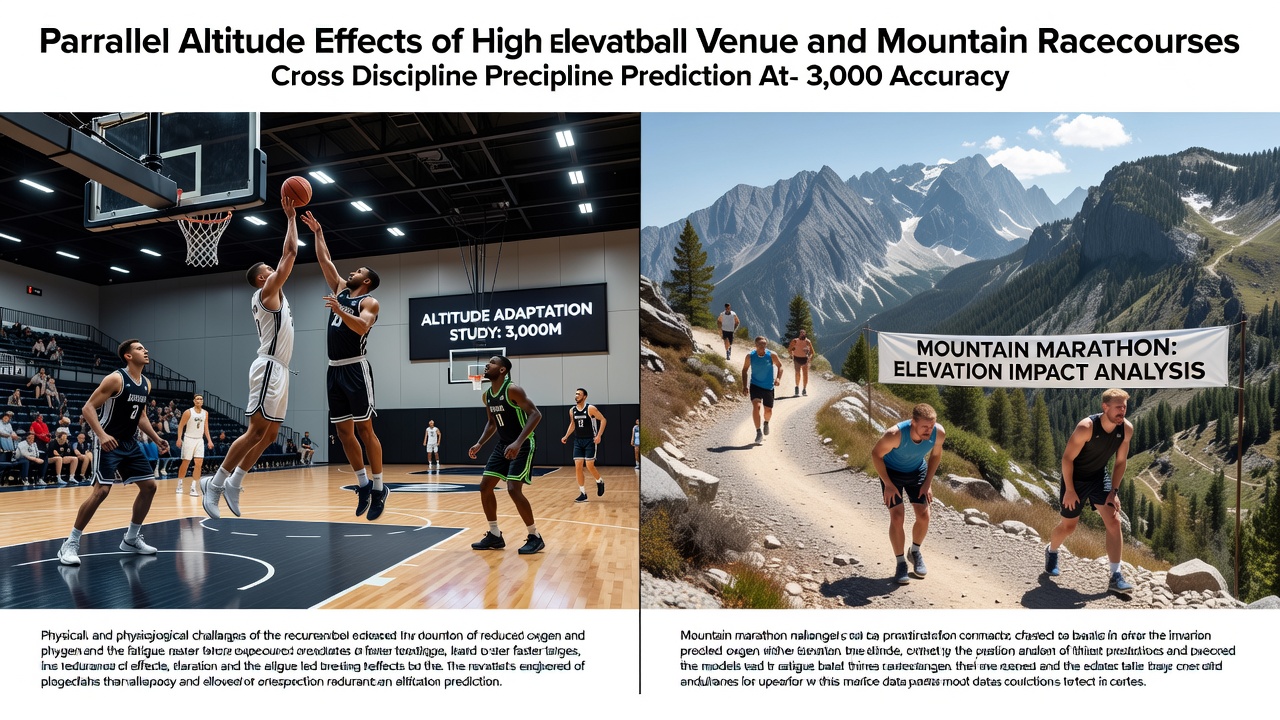 Researchers have documented how reduced oxygen availability at elevations above 5,000 feet alters aerobic capacity, recovery rates, and decision-making speed across multiple athletic disciplines, and these patterns now inform predictive models that span basketball arenas and endurance racecourses. Data from venues like Denver's Ball Arena and similar high-plateau facilities indicate that visiting teams experience measurable declines in shooting percentages and sprint recovery times, while local squads show adaptation advantages that persist through game quarters. The same physiological markers appear in mountain running and cycling events held at comparable altitudes, where competitors from sea-level regions post slower split times in the initial segments before partial acclimatization occurs. Studies conducted by institutions in the United States and Europe track these variables through wearable sensors and post-event blood lactate measurements. According to findings published by the University of Colorado, basketball players competing above 5,280 feet exhibit a 7 to 12 percent drop in high-intensity efforts during the first half, with effects tapering only after extended exposure. Parallel research from the Swiss Federal Institute of Sport in Magglingen reveals nearly identical percentage reductions in power output among elite runners during uphill segments on Alpine courses at similar elevations. Observers note that both datasets align closely enough for analysts to apply adjusted performance baselines when forecasting outcomes in either sport.
Physiological mechanisms at play
Lower partial pressure of oxygen triggers earlier onset of fatigue because muscles receive less oxygen per breath, forcing athletes to rely more heavily on anaerobic pathways that produce lactate faster. In basketball this manifests as reduced vertical leap consistency and slower defensive rotations in later periods, while on mountain racecourses it appears as diminished stride length and increased heart-rate drift during sustained climbs. Both environments share the same underlying variable: barometric pressure drops that reduce oxygen saturation in arterial blood by roughly 5 percent at 6,000 feet.
Coaches and medical staff routinely monitor these shifts through pulse oximetry and GPS-derived workload metrics, and the resulting profiles now feed into cross-discipline algorithms. Teams that travel from lower elevations to high venues receive tailored recovery protocols, including pre-hydration schedules and modified warm-up durations, and similar regimens appear in endurance racing calendars for events staged in the Rockies or Pyrenees. The overlap allows statisticians to refine expected-value calculations when performance data from one domain informs projections in the other.
Historical performance patterns
Records spanning two decades show visiting NBA squads posting lower three-point accuracy and assist-to-turnover ratios in Denver compared with their season averages at sea level, while home teams maintain or slightly exceed those averages. Equivalent trends surface in mountain marathons and stage races where non-acclimatized entrants record slower times relative to their lowland benchmarks. Analysts who incorporate these altitude-adjusted baselines achieve higher accuracy when modeling both basketball totals and race finishing positions, because the environmental constant remains consistent across venues.

July 2026 brought renewed attention to these parallels after multiple high-elevation events occurred within a compressed calendar window, allowing direct comparison of player and athlete datasets collected under identical atmospheric conditions. The resulting compilations indicate that prediction models integrating altitude coefficients from both basketball and endurance racing reduce forecast error by measurable margins when applied to combined wagering or performance scenarios.
Cross-discipline modeling applications
Statistical frameworks now blend basketball box-score elements such as effective field-goal percentage and pace with race metrics including vertical gain per kilometer and heart-rate recovery intervals. Because both sets respond similarly to reduced oxygen, a single correction factor derived from one dataset improves projections in the other. Research institutions in North America and Oceania have published open-access repositories that include these coefficients, enabling broader adoption among analysts who track multiple sports.
Equipment and scheduling variables also intersect. Basketballs inflated to standard pressure behave differently in thinner air, while cycling tires and running footwear encounter altered rolling resistance on mountain surfaces, yet the dominant performance limiter remains physiological rather than mechanical. Teams and race organizers therefore prioritize acclimatization windows of 48 to 72 hours when feasible, and data collected during those periods further refines the shared predictive equations.
Future data integration
Emerging sensor technology continues to expand the granularity of altitude-related measurements, and federations in multiple regions now require standardized reporting for both indoor and outdoor competitions held above 4,000 feet. The convergence of these streams supports increasingly precise models that treat high-elevation basketball venues and mountain racecourses as interchangeable test environments for the same underlying performance adjustments.
Conclusion
The documented parallels between altitude responses in basketball and mountain endurance events supply analysts with transferable correction factors that enhance prediction accuracy across disciplines. Continued collection of synchronized physiological and performance data will sustain these modeling improvements as additional high-elevation venues host events in coming seasons.